
Clinics · Guide
GCC & HCPC Compliant Marketing: What a Clinic Can and Can't Say
 By Rank NI · 29 May 2026 Updated 19 June 2026
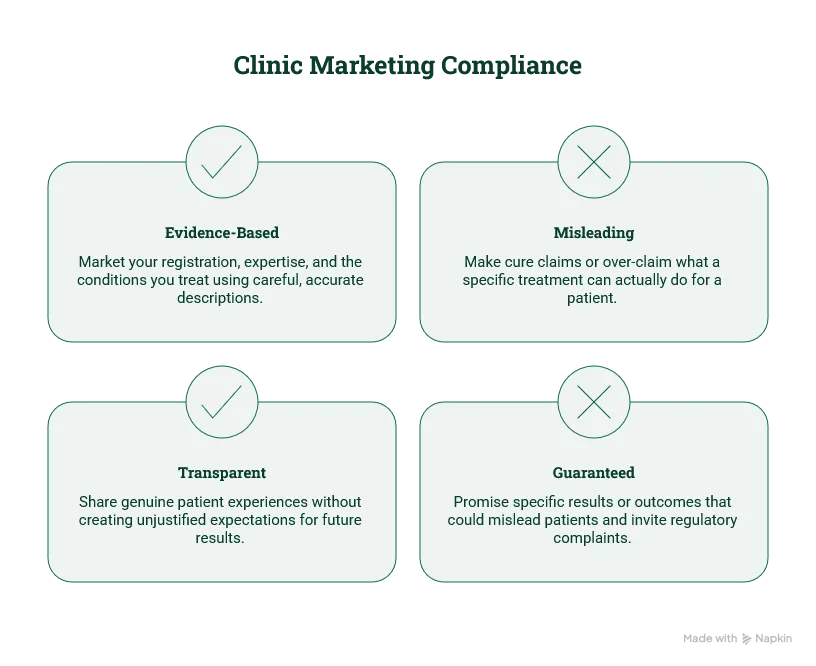
Short answer: the GCC, HCPC and GOsC all require clinic marketing to be accurate, honest and free of claims that could mislead patients or create unjustified expectations, no guaranteed outcomes, no cure claims, no over-claiming what treatment can do. You can market your registration, your expertise, the conditions you treat (described carefully) and genuine patient experience. You can’t promise results.
For a careful clinic owner, getting this right is the difference between marketing that builds trust and marketing that invites a complaint. Here’s the plain-English version.
(This is general guidance, not legal or regulatory advice. Always check the current guidance from your own regulator, it’s the definitive source.)
Why the rules exist, and why they’re a feature, not a bug
Healthcare regulators care about patients not being misled into treatment by exaggerated claims. So the HCPC (physiotherapists), GCC (chiropractors) and GOsC (osteopaths) all require marketing to be accurate and not to create unjustified expectations.
That sounds like a constraint. In practice it’s an advantage, because the same honesty that keeps you compliant is what a sceptical patient is looking for. The patient worried about being sold an open-ended course of treatment trusts the clinic that’s clear and measured, not the one promising miracles.
What you generally can say
- Your registration and qualifications: HCPC, GCC, GOsC, Chartered status, your team’s training. This is the strongest trust signal you have.
- The conditions you treat, described carefully and within the evidence (“we help with back pain, sciatica and sports injuries”).
- Genuine patient reviews about their experience and your service.
- Clear, transparent pricing, which also answers the patient’s biggest worry.
- Your availability (“private appointments, often within days”), which speaks honestly to the NHS-overflow patient.
What gets clinics into trouble
- Guaranteed outcomes: “pain gone in three sessions”, “100% recovery”.
- Cure claims or implying treatment fixes things beyond the evidence.
- “Miracle”, “breakthrough”, “revolutionary” framing.
- Testimonials that make clinical claims you couldn’t make yourself, a review saying “it cured my disc” can imply a claim the regulator wouldn’t allow.
- Misleading comparisons or unverifiable statistics.
This is also where generic marketing agencies create risk. An agency that promises you “30% growth” is making a business claim, fine in a sales pitch. But the same agency that splashes outcome promises across your patient-facing site has handed you a compliance problem. The promise to the clinic and the promise to the patient are different things, and only one of them is allowed.
How to market within the rules and still fill the diary
You market access, expertise and experience, not outcomes:
- Rank for the conditions patients search, with careful, accurate pages, see SEO for chiropractors and healthcare marketing.
- Win the map pack with a complete profile and genuine reviews, see Google Business Profile for clinics.
- Speak to the NHS wait factually (“appointments sooner than the current NHS wait”), see how NI clinics capture NHS overflow.
None of that requires a single claim a regulator would object to, and all of it fills a diary.
Why this is the question to ask an agency
If you’re choosing who builds your marketing, ask them how they handle the GCC or HCPC rules. A generalist who’s never heard of them will write you copy that ranks and then quietly exposes you. An agency that treats the rules as the brief, as we do, builds marketing that’s both effective and safe. That’s the whole approach behind our healthcare marketing and the wider marketing for physiotherapists in Belfast.
Book a free 10-minute audit and we’ll review your current marketing for both ranking and compliance, and tell you straight where it stands.